08.08.2014:
China connected 3.3 GW of new solar generation capacity to the national grid in the first half of 2014, almost double the amount it connected in the same period last year, reports Reuters, citing figures from China’s National Energy Administration (NEA). However, the figure represents just a fraction of China’s 2014 installation goal: the NEA recently revised up its total 2014 PV target from 10 GW to 13 GW. In July 2013, the Chinese government raised its cumulative 2015 PV target from 21 GW to 35 GW, and in May 2014, the government said it planned to increase the solar target to 70 GW cumulative by 2017. China had around 20 GW of operational PV capacity at the end of 2013, according to data compiled by Bloomberg. China aims to raise the share of non-fossil fuels in the overall energy mix to 10.7% by the end of this year from 9.8% at the end of 2013, reports Reuters.
© PHOTON
08 August 2014

05 August 2014
Worse news for Australia as India taps solar, Beijing bans coal : Renew Economy
China is moving ahead on plans to address its pollution problem by phasing out coal.
In Delhi last week, the Indian government committed to a plan to provide low-cost loans and grants to set up some of the world’s largest solar PV parks across the country, each of them comprising as much as 20 gigawatts of capacity, about 10 times what India has built to date....
According to official Chinese government statistics, coal use accounted for 25.4 per cent of the capital’s energy consumption in 2012 – a figure that is expected to shrink to less than 10 per cent by 2017.
...
Read the full article online
When will Abbott & Co realise that they have backed the wrong contender and break with King Coal in Australia? If they want to keep in government they need to soon!
30 July 2014
Solar industry provides far more jobs in Australia than coal : Renew Economy
Solar industry provides far more jobs in Australia than coal : Renew Economy:
Australia’s solar industry employs a “far larger” amount of people than its fossil-fuelled power stations, a new report has found.
The report, released on Monday by The Australia Institute says that in 2014, 4,300 solar PV businesses employed 13,300 people in Australia – a vast increase on 2008 numbers, when the industry only employed 1,800 people.
This was a “far larger” amount that the total employed in Australia’s coal-fired power stations, said the report, and a good deal larger that the total number of people working in the entire electricity generation sector, which amounted to 9,487 in 2007 according to the ABS, a figure which also included those employed in gas, hydro and renewable energy generation.
Australia’s biggest existing coal-fired power generators, such as Macquarie Generation and Stanwell, employed only 642 and 800 FTE workers respectively, said the TAI.
 “The solar industry is likely to become an even bigger employer in the near future as the price of both solar panels and battery storage come down,” says the report.
Australia’s solar industry employs a “far larger” amount of people than its fossil-fuelled power stations, a new report has found.
The report, released on Monday by The Australia Institute says that in 2014, 4,300 solar PV businesses employed 13,300 people in Australia – a vast increase on 2008 numbers, when the industry only employed 1,800 people.
This was a “far larger” amount that the total employed in Australia’s coal-fired power stations, said the report, and a good deal larger that the total number of people working in the entire electricity generation sector, which amounted to 9,487 in 2007 according to the ABS, a figure which also included those employed in gas, hydro and renewable energy generation.
Australia’s biggest existing coal-fired power generators, such as Macquarie Generation and Stanwell, employed only 642 and 800 FTE workers respectively, said the TAI.
it is estimated that an additional 8,000 jobs will be created in the four years from 2014 to 2018.
“The solar industry is likely to become an even bigger employer in the near future as the price of both solar panels and battery storage come down,” says the report.02 July 2014
Energy prices crash as Queensland solar takes hold : Renew Economy
Energy prices crash as Queensland solar takes hold : Renew Economy: "Energy prices crash as Queensland solar takes hold"
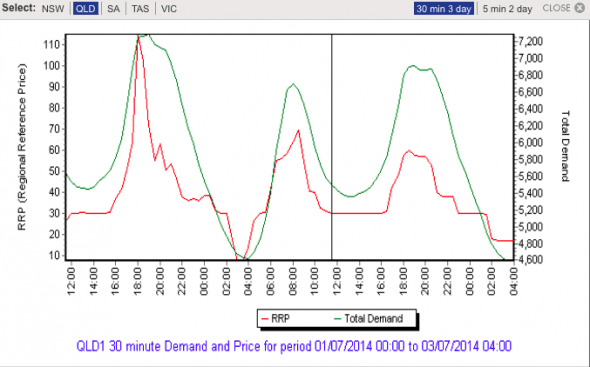
Wholesale electricity prices this week in Queensland have fallen below $30/MWh – see graph below – far below the levels of other states as mild weather and sunny condition reduced demand and generated a large amount of solar electricity.
...

Read the full article
'via Blog this'
Wholesale electricity prices this week in Queensland have fallen below $30/MWh – see graph below – far below the levels of other states as mild weather and sunny condition reduced demand and generated a large amount of solar electricity.
...
The fall in energy prices came as Abbott blamed renewable energy for lifting retail electricity bills. On Tuesday, Queensland electricity prices did indeed rise 18 per cent, but this was almost entirely the result of soaring network costs and rising gas prices. The impact of renewable energy on retail prices actually fell.
Abbott’s comments came despite the conclusion of his own hand-picked modellers, ACIL Allen, which said the renewable energy target would lower consumer bills over the medium to long term.
This confirms conclusions reached by other analysis, despite the fact that the numbers dialled into the modeling by ACIL Allen were “fossil fuel” friendly and did not reflect the real cost of renewables.
...
This graph of Queensland demand and prices on Monday and Tuesday from the Australian Energy Market Operator illustrates the problem for coal and gas generators. The middle of the day was when the fossil fuel generators used to generate most revenue, because demand was highest. Now, demand eases dramatically, as this graph shows. Demand is in the green, while the wholesale price in is the red line.
Read the full article
'via Blog this'
20 June 2014
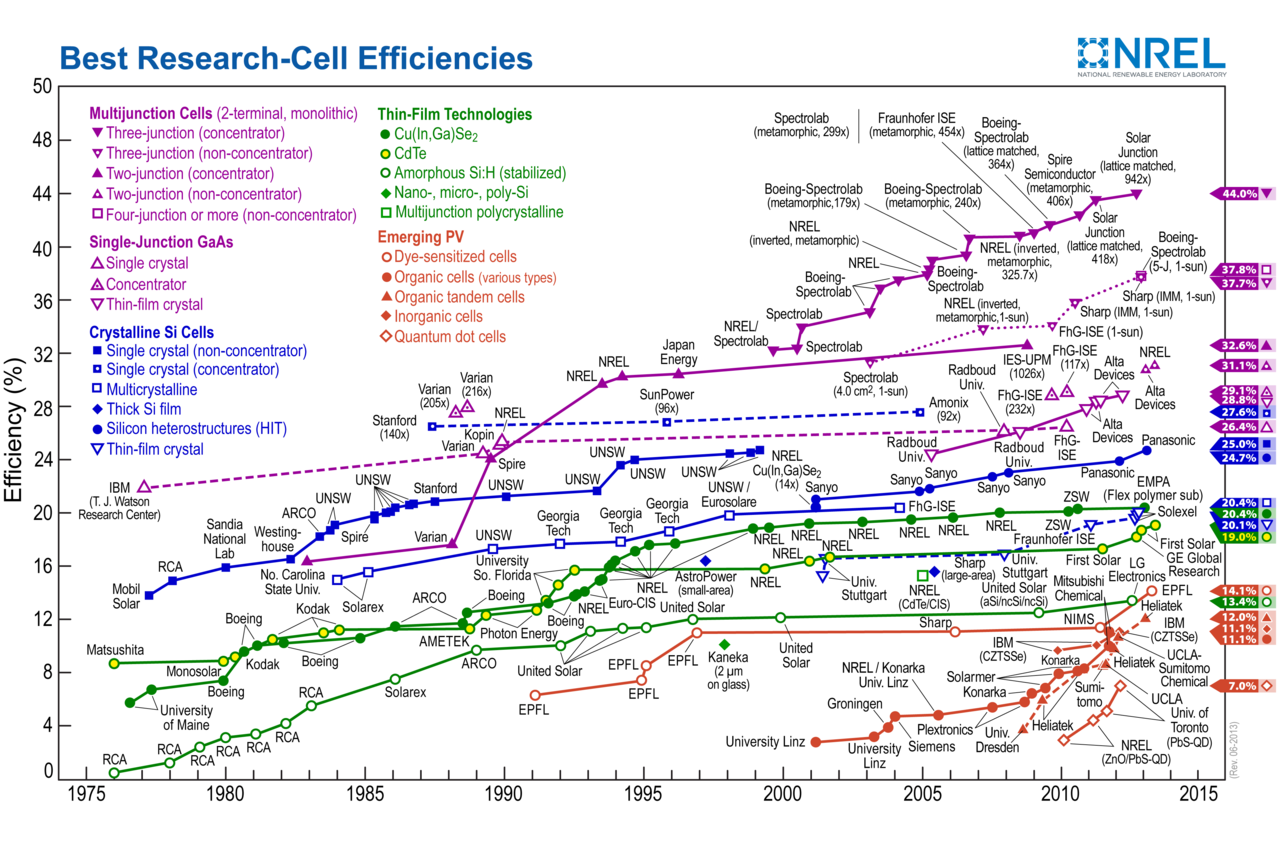
Which Solar Panels Are The Most Efficient?
Which Solar Panels Are The Most Efficient?
One answer is given in this brilliant overview:
 However, ist is questionable whether this is relevat for you.
Skip the focus on hypotheticals and irrelevant superlatives. Forget about what the “most efficient solar panels” are.
Why?
Check it out on this excellent web site!
One answer is given in this brilliant overview:
Skip the focus on hypotheticals and irrelevant superlatives. Forget about what the “most efficient solar panels” are.
Why?
Check it out on this excellent web site!
19 June 2014
Abengoa mulls 20MW solar tower + storage plant in WA : Renew Economy
Abengoa mulls 20MW solar tower + storage plant in WA : Renew Economy
Already proposed for a long time by the Greens something is finally happening with the help of Spain-based renewable energy giant Abengoa. The company has secured $450,000 in funds from the Australian Renewable Energy Agency to conduct a feasibility study for the project, which would be connected to the South West Interconnected System (SWIS), and could offset expensive grid upgrades, and avoid the cost of transporting expensive fossil fuels.
Just in time, regarding the wrecking ball that is swinging in Canberra.

Already proposed for a long time by the Greens something is finally happening with the help of Spain-based renewable energy giant Abengoa. The company has secured $450,000 in funds from the Australian Renewable Energy Agency to conduct a feasibility study for the project, which would be connected to the South West Interconnected System (SWIS), and could offset expensive grid upgrades, and avoid the cost of transporting expensive fossil fuels.
Just in time, regarding the wrecking ball that is swinging in Canberra.

16 July 2013
The WA Government considers power bill change - ABC News (Australian Broadcasting Corporation)
PV as scapegoat for losses from poles and wires
In 2009 Western Power published their proposal for a "Bi-directional Reference Service and Associated Tariff" which then already targeted Households with solar PV to pay for losses incurred by peak power demand - in vain. This proposal had to be published for public comment and - despite its complicated architecture trying to hide the true intent - in the end wasn't put into practice after strong opposition.
This time it isn't that clandestine an approach, the Barnett government is growing bolder. On ABC TV news on one hand the "Energy Minister Mike Nahan says changes to the way household energy costs are structured will not result in higher prices.", on the other hand they state that "rapid increase in the number of households installing rooftop solar panels has contributed to a drop in energy consumption and a revenue shortfall for state-owned power companies.
So the State Government is considering changing the way West Australians are charged for energy use, to protect the long-term viability of the state-owned power grid."
"What we would do is [reduce] the user charge and increase the fixed price," he said.

This means that PV households - which are still connected to the grid but using less power from it than other households - will hardly benefit from a price reduction for the use of electricity and instead will be forced to pay more for poles and wires. They had invested 1000's of dollars earlier in PV attempting to becomes less reliable on the grid, to become a bit more self sufficient, to save a dollar or two, and to do their bit on climate change.
Instead of reading the signs of the times by admitting their power policies have failed and need shifting, e.g. by modernising the grid towards a smart grid (in the non-controlling but load balancing sense) and penalising high power usage the state government tries to save their stone-age assets in favour of modernising an industry, protecting everything that looks like, feels like, and smells like mining; trying to lure the unwary voter with low prices for consumption which in turn would encourage even higher consumption, in these times when use of fossil fuels is indicated left, right, and center.
Don't be fooled by the COALition government (aptly named after their favourite industry?!) trying to taint their true intentions with words such as "We are [also] generating less electricity from coal - that is good, that's what we wanted." The libs have never intended this hence their actions towards the opposite direction:
"Dr Nahan says about 2,000 households are applying to install photovoltaics (solar panels) every week and the government must change its charging system to reflect the trend" ... to recoup lost income for the state budget.
Subscribe to:
Posts (Atom)