75% of Perth homes could have solar by 2035: IMO | Climate Spectator:
"Western Australia's energy market operator has forecast that, under a high-case scenario, there could be much as three out of four homes with solar power in Perth by 2035 with saturation of the business market of 90%, The West Australian reports.
According to the newspaper, the Independent Market Operator report found under a mid-case scenario the South West grid's solar capacity could rise from 435MW in 2014-15 to 1405MW by 2024-25, with it reaching 2400MW under the high-case scenario.
The IMO also said home battery installations could be financially viable by next year with thousands taking up the systems by 2020. It forecasts a take-up of 16,000 systems by 2025 in its mid-case scenario and 26,000 under the high-case predictions."
The people in parliament better listen to what's going on!
'via Blog this'

29 June 2015
Underwater Noise Destructive to Environment
What does 280dB mean?
That is 120 dB x 10^16; or in other terms: 10,000,000,000,000,000 times louder than a starting jet air plane!This incomprehensible amount of noise is produced under water where oil and gas companies explore new resource fields.
While ships' sonar devices have been linked to whales beaching themselves, this situation is untenable. Hope to illustrate it with a graph:
 |
| Can't stand that noise! |
G7 Leaders Agree On Action To Limit Global Warming To 2 Degrees
G7 Leaders Agree On Action To Limit Global Warming To 2 Degrees
Group of Seven (G7) leaders agreed to limit global warming to 2°C at a meeting in Germany on Monday 8th June 2015, a feat they hope to accomplish by reducing their carbon emissions, mobilizing $100 billion a year for climate change mitigation, and facilitating more investment in developing nations.
...
The G7 declaration did call for “binding rules” that would “enhance transparency and accountability” as nations work toward achieving their carbon-reduction targets. But, experts say, violating those mechanisms – if ultimately included in any agreement in December – would not result in any sort of “enforcement sanctions,” explains Jennifer Morgan, global director of the climate program at the World Resources Institute.
...
The final agreement offered “support” for 40 to 70 percent reductions by 2050, compared to 2010 levels.
Read the full story on Climate Progress and on U.S.News.
07 October 2014
China coal consumption down 23% as more funds dump fossil fuels : Renew Economy
Divestment gains momentum as China reduces coal imports further:
...Deutsche Bank reported on Monday that a survey of thermal coal used in China by six major coastal electric utilities shows that consumption declined by 23 per cent yoy during the August-September period.
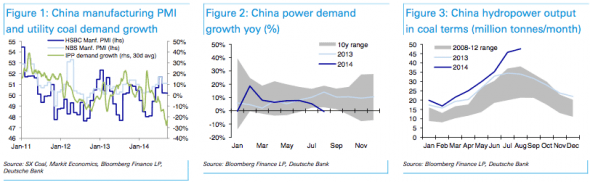
...
In Australia this week, the $8 billion Local Government Super Fund announced it would divest $25 million of shares in companies that generate more that one-third of their income from “high carbon sensitive” activities, including coal and tar sands mining and coal-fired power generation.
...
But, as the BNEF report also noted, the $5 trillion global shift out of fossil fuels will be “far from easy,” requiring a massive scale-up of new investment vehicles.
...
Read the full story online
'via Blog this'
26 September 2014
Up to $39bln a year - the cost of unpriced energy pollution in Australia : Renew Economy
A report, released on Tuesday by the Climate Institute, has found that Australia’s polluting energy sector benefits from an annual subsidy of $14-39 billion from the unpriced cost of climate damages on economic growth, environmental systems, health, and security.
 The total carbon subsidy to electricity between now and 2030 would reach $165-500 billion, even if the current RET stays in place. If the RET is curbed, the subsidy would increase by about $0.7-2 billion annually. If the RET were abolished altogether (and current arrangements grandfathered), the carbon subsidy would increase by about $0.8-2.5 billion annually.
...
“Other countries like the United States, Canada and the United Kingdom recognise the economic costs of carbon pollution, and the IMF is calling on all countries to end this subsidy to fossil fuels”
Read the full article on RenewEconomy
Enough reasons to take your saved or invested money out of the industries causing or supporting the pollution and into sustainable organisations and industries.

...
“Other countries like the United States, Canada and the United Kingdom recognise the economic costs of carbon pollution, and the IMF is calling on all countries to end this subsidy to fossil fuels”
Read the full article on RenewEconomy
Enough reasons to take your saved or invested money out of the industries causing or supporting the pollution and into sustainable organisations and industries.
08 August 2014
China added 3.3 GW of new PV capacity in the first half of 2014 : Photon
08.08.2014:
China connected 3.3 GW of new solar generation capacity to the national grid in the first half of 2014, almost double the amount it connected in the same period last year, reports Reuters, citing figures from China’s National Energy Administration (NEA). However, the figure represents just a fraction of China’s 2014 installation goal: the NEA recently revised up its total 2014 PV target from 10 GW to 13 GW. In July 2013, the Chinese government raised its cumulative 2015 PV target from 21 GW to 35 GW, and in May 2014, the government said it planned to increase the solar target to 70 GW cumulative by 2017. China had around 20 GW of operational PV capacity at the end of 2013, according to data compiled by Bloomberg. China aims to raise the share of non-fossil fuels in the overall energy mix to 10.7% by the end of this year from 9.8% at the end of 2013, reports Reuters.
© PHOTON
China connected 3.3 GW of new solar generation capacity to the national grid in the first half of 2014, almost double the amount it connected in the same period last year, reports Reuters, citing figures from China’s National Energy Administration (NEA). However, the figure represents just a fraction of China’s 2014 installation goal: the NEA recently revised up its total 2014 PV target from 10 GW to 13 GW. In July 2013, the Chinese government raised its cumulative 2015 PV target from 21 GW to 35 GW, and in May 2014, the government said it planned to increase the solar target to 70 GW cumulative by 2017. China had around 20 GW of operational PV capacity at the end of 2013, according to data compiled by Bloomberg. China aims to raise the share of non-fossil fuels in the overall energy mix to 10.7% by the end of this year from 9.8% at the end of 2013, reports Reuters.
© PHOTON
05 August 2014
Worse news for Australia as India taps solar, Beijing bans coal : Renew Economy
China is moving ahead on plans to address its pollution problem by phasing out coal.
In Delhi last week, the Indian government committed to a plan to provide low-cost loans and grants to set up some of the world’s largest solar PV parks across the country, each of them comprising as much as 20 gigawatts of capacity, about 10 times what India has built to date....
According to official Chinese government statistics, coal use accounted for 25.4 per cent of the capital’s energy consumption in 2012 – a figure that is expected to shrink to less than 10 per cent by 2017.
...
Read the full article online
When will Abbott & Co realise that they have backed the wrong contender and break with King Coal in Australia? If they want to keep in government they need to soon!
30 July 2014
Solar industry provides far more jobs in Australia than coal : Renew Economy
Solar industry provides far more jobs in Australia than coal : Renew Economy:
Australia’s solar industry employs a “far larger” amount of people than its fossil-fuelled power stations, a new report has found.
The report, released on Monday by The Australia Institute says that in 2014, 4,300 solar PV businesses employed 13,300 people in Australia – a vast increase on 2008 numbers, when the industry only employed 1,800 people.
This was a “far larger” amount that the total employed in Australia’s coal-fired power stations, said the report, and a good deal larger that the total number of people working in the entire electricity generation sector, which amounted to 9,487 in 2007 according to the ABS, a figure which also included those employed in gas, hydro and renewable energy generation.
Australia’s biggest existing coal-fired power generators, such as Macquarie Generation and Stanwell, employed only 642 and 800 FTE workers respectively, said the TAI.
 “The solar industry is likely to become an even bigger employer in the near future as the price of both solar panels and battery storage come down,” says the report.
Australia’s solar industry employs a “far larger” amount of people than its fossil-fuelled power stations, a new report has found.
The report, released on Monday by The Australia Institute says that in 2014, 4,300 solar PV businesses employed 13,300 people in Australia – a vast increase on 2008 numbers, when the industry only employed 1,800 people.
This was a “far larger” amount that the total employed in Australia’s coal-fired power stations, said the report, and a good deal larger that the total number of people working in the entire electricity generation sector, which amounted to 9,487 in 2007 according to the ABS, a figure which also included those employed in gas, hydro and renewable energy generation.
Australia’s biggest existing coal-fired power generators, such as Macquarie Generation and Stanwell, employed only 642 and 800 FTE workers respectively, said the TAI.
it is estimated that an additional 8,000 jobs will be created in the four years from 2014 to 2018.
“The solar industry is likely to become an even bigger employer in the near future as the price of both solar panels and battery storage come down,” says the report.02 July 2014
Energy prices crash as Queensland solar takes hold : Renew Economy
Energy prices crash as Queensland solar takes hold : Renew Economy: "Energy prices crash as Queensland solar takes hold"
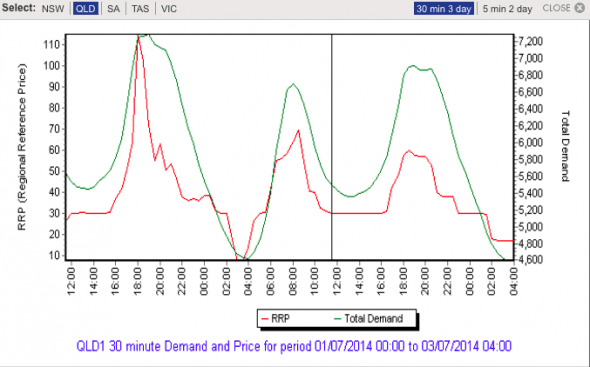
Wholesale electricity prices this week in Queensland have fallen below $30/MWh – see graph below – far below the levels of other states as mild weather and sunny condition reduced demand and generated a large amount of solar electricity.
...

Read the full article
'via Blog this'
Wholesale electricity prices this week in Queensland have fallen below $30/MWh – see graph below – far below the levels of other states as mild weather and sunny condition reduced demand and generated a large amount of solar electricity.
...
The fall in energy prices came as Abbott blamed renewable energy for lifting retail electricity bills. On Tuesday, Queensland electricity prices did indeed rise 18 per cent, but this was almost entirely the result of soaring network costs and rising gas prices. The impact of renewable energy on retail prices actually fell.
Abbott’s comments came despite the conclusion of his own hand-picked modellers, ACIL Allen, which said the renewable energy target would lower consumer bills over the medium to long term.
This confirms conclusions reached by other analysis, despite the fact that the numbers dialled into the modeling by ACIL Allen were “fossil fuel” friendly and did not reflect the real cost of renewables.
...
This graph of Queensland demand and prices on Monday and Tuesday from the Australian Energy Market Operator illustrates the problem for coal and gas generators. The middle of the day was when the fossil fuel generators used to generate most revenue, because demand was highest. Now, demand eases dramatically, as this graph shows. Demand is in the green, while the wholesale price in is the red line.
Read the full article
'via Blog this'
20 June 2014
Which Solar Panels Are The Most Efficient?
Which Solar Panels Are The Most Efficient?
One answer is given in this brilliant overview:
 However, ist is questionable whether this is relevat for you.
Skip the focus on hypotheticals and irrelevant superlatives. Forget about what the “most efficient solar panels” are.
Why?
Check it out on this excellent web site!
One answer is given in this brilliant overview:
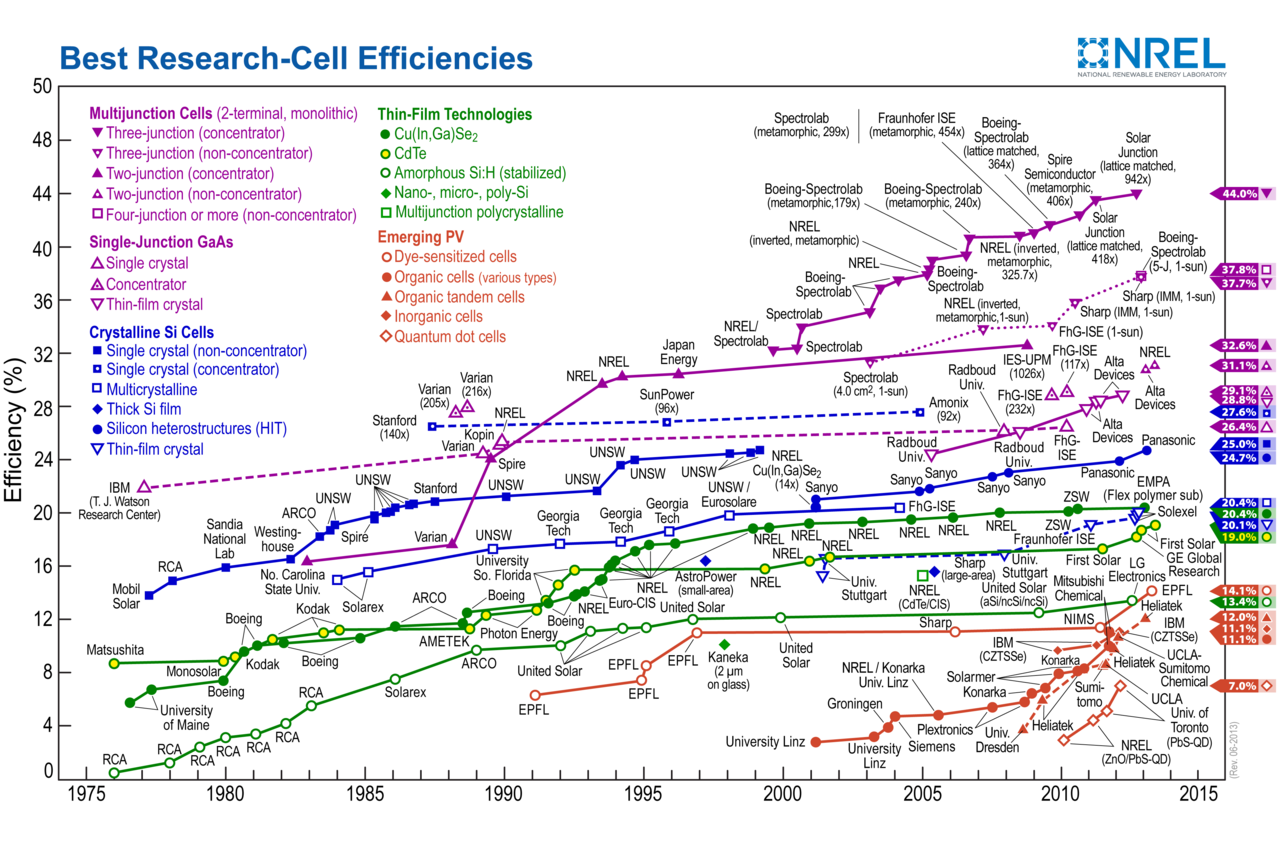
Skip the focus on hypotheticals and irrelevant superlatives. Forget about what the “most efficient solar panels” are.
Why?
Check it out on this excellent web site!
19 June 2014
Abengoa mulls 20MW solar tower + storage plant in WA : Renew Economy
Abengoa mulls 20MW solar tower + storage plant in WA : Renew Economy
Already proposed for a long time by the Greens something is finally happening with the help of Spain-based renewable energy giant Abengoa. The company has secured $450,000 in funds from the Australian Renewable Energy Agency to conduct a feasibility study for the project, which would be connected to the South West Interconnected System (SWIS), and could offset expensive grid upgrades, and avoid the cost of transporting expensive fossil fuels.
Just in time, regarding the wrecking ball that is swinging in Canberra.

Already proposed for a long time by the Greens something is finally happening with the help of Spain-based renewable energy giant Abengoa. The company has secured $450,000 in funds from the Australian Renewable Energy Agency to conduct a feasibility study for the project, which would be connected to the South West Interconnected System (SWIS), and could offset expensive grid upgrades, and avoid the cost of transporting expensive fossil fuels.
Just in time, regarding the wrecking ball that is swinging in Canberra.

16 July 2013
The WA Government considers power bill change - ABC News (Australian Broadcasting Corporation)
PV as scapegoat for losses from poles and wires
In 2009 Western Power published their proposal for a "Bi-directional Reference Service and Associated Tariff" which then already targeted Households with solar PV to pay for losses incurred by peak power demand - in vain. This proposal had to be published for public comment and - despite its complicated architecture trying to hide the true intent - in the end wasn't put into practice after strong opposition.
This time it isn't that clandestine an approach, the Barnett government is growing bolder. On ABC TV news on one hand the "Energy Minister Mike Nahan says changes to the way household energy costs are structured will not result in higher prices.", on the other hand they state that "rapid increase in the number of households installing rooftop solar panels has contributed to a drop in energy consumption and a revenue shortfall for state-owned power companies.
So the State Government is considering changing the way West Australians are charged for energy use, to protect the long-term viability of the state-owned power grid."
"What we would do is [reduce] the user charge and increase the fixed price," he said.

This means that PV households - which are still connected to the grid but using less power from it than other households - will hardly benefit from a price reduction for the use of electricity and instead will be forced to pay more for poles and wires. They had invested 1000's of dollars earlier in PV attempting to becomes less reliable on the grid, to become a bit more self sufficient, to save a dollar or two, and to do their bit on climate change.
Instead of reading the signs of the times by admitting their power policies have failed and need shifting, e.g. by modernising the grid towards a smart grid (in the non-controlling but load balancing sense) and penalising high power usage the state government tries to save their stone-age assets in favour of modernising an industry, protecting everything that looks like, feels like, and smells like mining; trying to lure the unwary voter with low prices for consumption which in turn would encourage even higher consumption, in these times when use of fossil fuels is indicated left, right, and center.
Don't be fooled by the COALition government (aptly named after their favourite industry?!) trying to taint their true intentions with words such as "We are [also] generating less electricity from coal - that is good, that's what we wanted." The libs have never intended this hence their actions towards the opposite direction:
"Dr Nahan says about 2,000 households are applying to install photovoltaics (solar panels) every week and the government must change its charging system to reflect the trend" ... to recoup lost income for the state budget.
14 July 2013
Wind to Double and Solar to Triple in 6 Years : Discovery News
Latest prognosis of the conservative International Energy Agency
... is painting a picture stakeholders in the fossul fuel industry can't be liking very much:"Total renewable electricity generation grew strongly in 2012, increasing by 8.2% from 2011. In absolute terms, global renewable generation in 2012 exceeded the electricity consumption of China. Part of the strength in 2012 growth stemmed from stronger-than-anticipated hydropower production, particularly in China. Yet it also reflected a continued rapid build-out of non-hydro sources, whose generation rose by 16% year-on-year. Among the OECD regions, non-hydro renewable generation was the second largest source of power generation growth in 2012, expanding by 90 TWh. By comparison, gas-fired generation rose by over 150 TWh, while both coal and nuclear declined."

Read the executive summary of the report in full.
With Tony Abbot (Liberals) vowing to scrap the price on carbon and Kevin Rudd (Labour) going half the same way Australian politicians appear to be still trying to buck the worldwide trend ignoring the will of the majority of Australians who in record numbers have installed solar PV on their roofs.
Question remains why the same majority acts as if there are only the aforementioned political parties which do everything to satisfy the billionaires of the country who run the coal mining, fossil fuel power generation, and media industries.
10 June 2013
When Big Coal goes solar | Business Spectator
Are they getting the message?
Or is it more sinister and ruthless, in that they see the good in renewables and decide that the quick buck can be made today with fossils which is for others to pay today and tomorrow?
Maybe it doesn't matter, make of it what you want. I believe it will be an advertisement for renewable energy, especially that the old school is not only using but also displaying use of the new school.
For that bit they deserve to be congratulated.

Don't forget to read the full article, very well done on Climate Spectator.
19 May 2013
Dyesol Announces 'Quantum Leap' In Dye Solar Cell Efficiency : Renewable Energy News :
In 2010, solid-state DSC performance was at just 5%, but today ...
... the performance that has been achieved is a lot higher: 11.3% at full sun!
While this is still way less than the "normal" panel efficiencies achieved today, it is of particular interest as this technology doesn't rely on being installed as a panel.
"DSC technology is described by the company as "artificial photosynthesis" that uses an electrolyte, a layer of titania and ruthenium dye deposited on glass, metal or polymer substrates."But it has even more advantages, about which you can read on Energy Matters
07 May 2013
New Battery Efficiently Stores Solar and Wind Energy | The Daily Fusion
New Battery Efficiently Stores Solar and Wind Energy | The Daily Fusion
Scientists from the U.S. Department of Energy’s (DOE) SLAC National Accelerator Laboratory and Stanford University have developed a relatively cheap, long-life “flow” battery that can be used to mitigate power fluctuations from solar and wind energy plants, therefore enabling them to become major suppliers to the electrical grid.
...
 |
| These diagrams compare Stanford/SLAC’s new lithium-polysulfide flow battery design with conventional “redox” flow batteries. The new flow battery uses only one tank and pump and uses a simple coating instead of an expensive membrane to separate the anode and cathode. (Credit: Greg Stewart/SLAC) |
...
The new Stanford/SLAC battery design uses only one stream of molecules and does not need a membrane at all. Its molecules mostly consist of the relatively inexpensive elements lithium and sulfur, which interact with a piece of lithium metal coated with a barrier that permits electrons to pass without degrading the metal. When discharging, the molecules, called lithium polysulfides, absorb lithium ions; when charging, they lose them back into the liquid. The entire molecular stream is dissolved in an organic solvent, which doesn’t have the corrosion issues of water-based flow batteries.
“In initial lab tests, the new battery also retained excellent energy-storage performance through more than 2,000 charges and discharges, equivalent to more than 5.5 years of daily cycles."
02 April 2013
Suntech Bankrupt and Bosch Dropping Out of Solar | The Solar Drop - DIY Solar and Solar Energy News
Suntech Bankrupt and Bosch Dropping Out of Solar | The Solar Drop - DIY Solar and Solar Energy News
Good news for consumers, but somehow frightening to watch how the companies which did the heavy lifting in making Solar PV affordable have to make way for others.
Well, who knows how strongly this was a matter of manipulation versus forces of the market?
Maybe a sign of what might happen to the fossil fuel industry some time down the track?
14 February 2013
Liberals to break up DEC if elected - ABC News (Australian Broadcasting Corporation)
Break them up, send them away, make them ineffective ...
... so that the path to even more mining gets less and less obstructed by those at DEC who are nothing but an administrative pain in the neck!Or so the Liberals' motivation seems to be. Why not send the Department of Mining and Petroleum in the country, to where the mining is?
Make them live and work right in the middle of the proposed fracking fields?
Do they really believe that one can eat money?
02 February 2013
On its way from Australia - even worse carbon emissions
The world's second largest contributor of new CO2 emissions from fossil fuels if fully realised
 It is hard to believe but reality everyday: The more evidence we have that alternative energy production becomes cheaper and more and more available, the more conventional, fossil fuel production get pushed by politicians and, of course, conventional corporations.
Queensland and New South Wales have endured the sixth once-in-a-hundred-years event in 10 years in the from of floods, fires, storms and droughts. Yet the corresponding state premiers cut back on renewable energy incentives, undo projects and prefer to pay for damage done by these catastrophes over investing in preventive measures.
The NSW bill last year was around $800 million for damage on public property alone, preventive measures were paid for in the order of merely $8.4 million, of which most was research.
Pathetic!
One can only hope that if Canberra moves to protect Great Barrier Reef heritage status this would put a decisive stop to expansions in this respect.
Unfortunately I doubt it.
Maybe the campaign behind the following would work?
12 January 2013
Chilean authorities approve 3.1 GW solar project
Australian Authorities are still in love with king coal

© Gilberto Perez / Wikimedia Commons CC-by-SA
09.01.2013: A total of 3.1 GW of PV projects have been approved by the authority Servicio de Evaluación Ambiental (SEA) in Chile, according to the December report of the Chilean renewable energy research institute Centro de Energías Renovables (CER). The PV projects currently under examination for approval have a total capacity of 908 MW. The report notes that despite the increase in PV projects submitted during the last months, the country has only 2.4 MW of on-grid PV system power up and running, while 2.5 MW of projects are under construction. Furthermore, the report reveals that 4.8 MW of small-sized off-grid PV systems have been installed in the Chile. Source: Centro de Energías Renovables (CER)
http://www.cer.gov.cl
http://cer.gob.cl/boletin/diciembre2012/Reporte%20Diciembre.pdf
The complete press release can be viewed in PHOTON's archive using the following link:
http://www.photon-international.com/newsletter/document/72972.pdf
Subscribe to:
Posts (Atom)